Green Storytelling and Emotional Engagement What Did We Learn from Audience Responses to Families Like Ours?
Nathali H.S. Pilegaard
Introduction
In recent years, increasing attention has been directed toward so-called green storytelling: narratives that engage with sustainability through films, television series, and other media forms. But what happens when audiences encounter these stories? Can they create reflection, emotional engagement, or perhaps even influence behavior? In connection with the Danish TV 2 series Families Like Ours (2024), we conducted a small audience survey involving 258 respondents to explore how viewers experienced the series’ sustainability themes, characters, and climate narrative. The results suggest that the series primarily generated emotional reflection rather than direct behavioral change. Many respondents described how the series made them think about climate change, migration, social inequality, and human behavior during times of crisis. At the same time, the material also highlights some of the challenges involved in working with green storytelling. Several viewers experienced the series as emotionally powerful, yet still missed a sense of hope, agency, or stronger identification with the characters. In this article, we take a closer look at some of the patterns that emerged in the survey and what they may reveal about the potentials and limitations of green storytelling.
What is the Series About?
Families Like Ours is a Danish drama series directed by Thomas Vinterberg. The series is set in a near future where Denmark, due to escalating climate change, faces a state-organized total evacuation. All citizens are required to leave the country with no guarantee of return.
The narrative follows a range of characters and explores their different responses to this crisis. At the center of the story is the young girl Laura, whose family becomes divided as they are forced to leave Denmark and travel to different destinations across Europe. Her father, Jacob, has access to privileged information and better opportunities through his work, while her mother, Fanny, is sent into far more uncertain conditions.
Alongside Laura and her family, the series follows several other characters and families who experience the climate crisis very differently depending on their economic circumstances, relationships, and social position.
Climate change functions as the overarching dramatic framework, but the series equally foregrounds the social and emotional consequences of systemic collapse. Themes such as migration, inequality, privilege, relationships, and moral responsibility become central to the story’s portrayal of a society in crisis.
More Than a Climate Story
Although Families Like Ours clearly positions climate change as the overarching framework of the story, our audience survey shows that many viewers experienced the series as much more than climate fiction. For many, climate became the starting point for a story about people, relationships, privilege, and the experience of losing one’s home and sense of security.
Several respondents described the series primarily as a story about refugees and human consequences rather than about climate itself. Two respondents, for example, wrote:
“The series made me think about what I would do as a natural disaster refugee.”
“It made me try to understand what it is like to be a refugee.”
Others pointed to how the series made climate-related migration feel more personal and emotionally immediate:
“The idea of migration because of climate change feels more present.”
At the same time, many responses revolved around social relationships, moral dilemmas, and human behavior during times of crisis. Climate change was therefore not necessarily experienced as the emotional center of the narrative. Rather, it was the relationships between people that became central.
This became particularly visible when we asked respondents to describe what Families Like Ours made them think about, or whether the series had influenced their thoughts or behavior in relation to sustainability or other issues. One respondent wrote:
“It is the relationships in the middle of chaos that become decisive.”
The survey therefore points to something important in relation to green storytelling:
Audiences often engage more strongly with the human consequences of the climate crisis than with climate science itself or with concrete environmental issues.
It is through identification, emotions, and social dilemmas that sustainability becomes meaningful and emotionally present.
Fanny, Emotions, and Identification
One of the most interesting findings in the survey concerns which characters audiences felt inspired by. Here, the character Fanny (played by Paprika Steen) stood out the most. 17% of respondents identified her as the most inspiring character in the series.
What is interesting is not only that Fanny made an impression, but also why she did. Respondents’ explanations frequently revolved around compassion, responsibility, realism, and dignity under pressure. Several described her as a character trying to do the right thing in an impossible situation, even when it came at a personal cost. One respondent, for example, wrote:
“Fanny cared more about doing what was right rather than what was easy.”
Another highlighted her credibility and realism:
“She feels like the one with the most realistic reaction.”
This points to something central in relation to green storytelling:
Audiences do not necessarily identify most strongly with characters who speak directly about climate change or sustainability. Instead, they often connect more deeply with characters navigating human dilemmas in a world shaped by crisis, uncertainty, and social tensions.
In this sense, sustainability becomes not only a question of climate and the environment, but also of care, responsibility, and the ways people treat one another under pressure.
Green Storytelling Created Reflection, Not Necessarily Action
One of the clearest patterns in the survey is that Families Like Ours generated reflection more than concrete behavioral change. Very few respondents described major changes in their everyday lives or lifestyles after watching the series. However, many pointed out that the series sparked thoughts and emotions.
Overall, audience responses to the series were relatively positive, although reactions were also marked by a certain degree of ambivalence and emotional complexity.
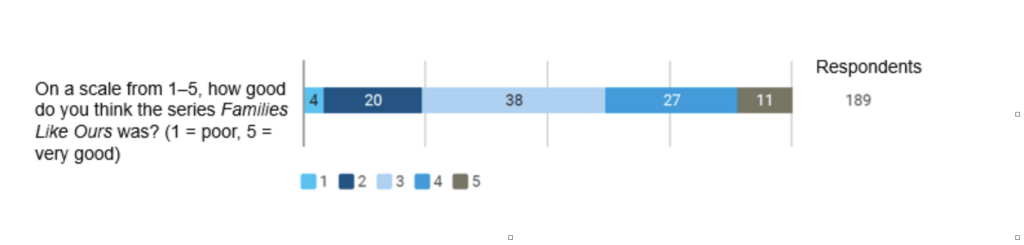
The survey results suggest that viewers were emotionally engaged by the series, even when they disagreed about its characters, realism, or ending. Many respondents described the series as thought-provoking and emotionally intense, while others experienced frustration, anxiety, or a lack of hope within the narrative.
Some respondents, for example, described an increased awareness of climate risks and future consequences. Others highlighted how the series led to conversations with family and friends about climate change, refugees, and society. One respondent described this by writing that the series “has led to new conversations.”
For a smaller number of viewers, the series also resulted in minor behavioral changes. Some respondents mentioned that they had started eating more vegetarian meals or had become more conscious about turning off lights and reducing energy use.
At the same time, the material also reveals a more complex emotional response. Several viewers experienced the series as emotionally heavy, anxiety-inducing, or characterized by a sense of helplessness rather than hope. One respondent wrote: “It made me more depressed than inspired.”
Many respondents also called for more direction, hope, or possibilities for action within the narrative. Several experienced the series more as a disaster drama than as a story that motivated concrete action.
The impact may not primarily lie in direct behavioral change. Instead, its significance may be found in its ability to create emotional engagement, identification, conversations, and imaginative reflection about possible climate futures.
When Stories Make the Climate Crisis Feel Real
The survey of Families Like Ours suggests that green storytelling does not necessarily change people’s behavior overnight. However, it may do something else that is just as important: it can make sustainability feel emotionally present, personal, and deeply human.
In particular, the stories and characters audiences could identify with were the ones that created engagement, reflection, and conversations.
The findings therefore suggest that green storytelling may work most powerfully when sustainability is not presented merely as an abstract issue, but as something that affects relationships, everyday life, identity, and the feeling of safety and belonging.
At the same time, the material also points to an important challenge. Several respondents called for more hope, clearer possibilities for action, and greater recognizability within the narrative.
This highlights how important the balance between realism, emotion, and a sense of agency is if green storytelling is to engage audiences without simply creating feelings of helplessness.
Perhaps this is where green storytelling holds its greatest potential, not necessarily in providing ready-made solutions, but in creating imagination, reflection, and conversations about the futures we may be moving toward.