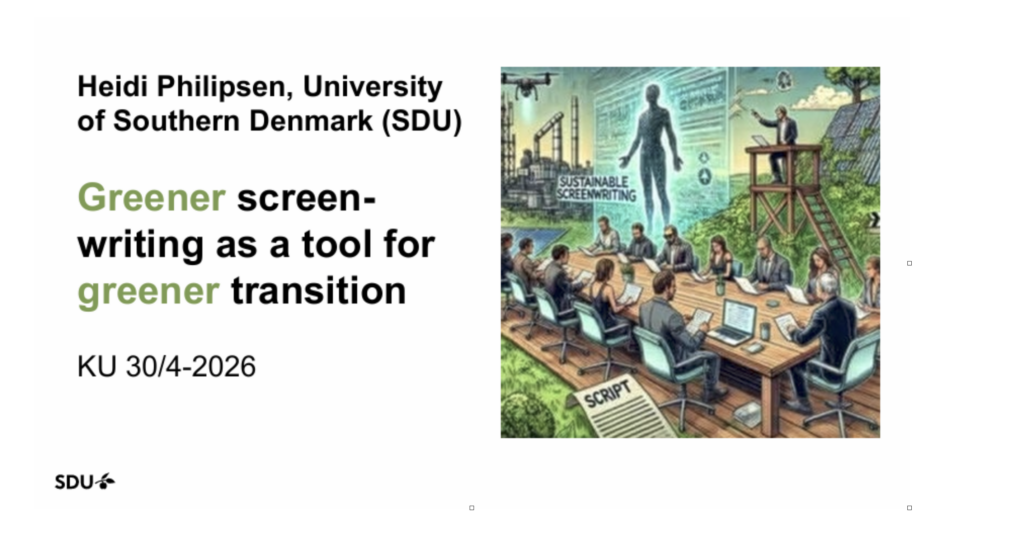
Greener screenwriting as a tool for greener transition
Seminar at Copenhagen University, 30/4-2026
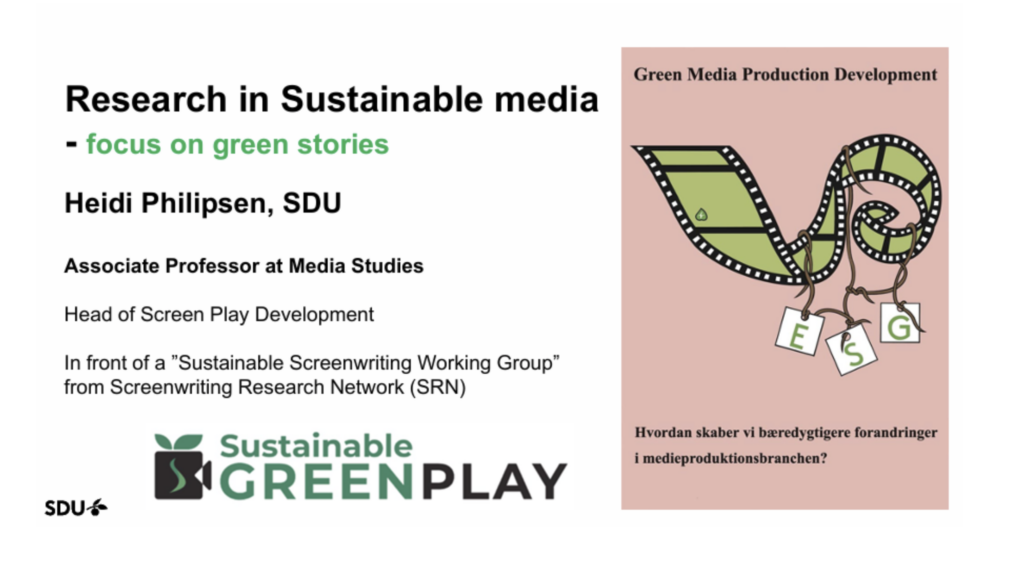
Research in Sustainable Media
I am Associate Professor at Media Studies from SDU, and also head of an education called Screen Play Development. But I am first and foremost a researcher in the field of conditions for creative processes within the media industry.
However, over the last 3-4 years I have discovered how my research into creativity within constraints suits the field of sustainability crises very well.
I have therefore been a part of several research projects on sustainable media transition – including one called: “Green Media Production Development”. Together with several media companies. Where we published this catalog, you can see on the slide and on Greenstorytelling.dk.
And another project about screenwriting called Sustainable sGreenplay where we worked with screenwriters and writing students.
Seminar:
Sustainable Film and Television Production: Current Research and Pressing Issues
Dato:
30. april 2026
Oplægsholder:
Heidi Philipsen, SDU
Sustainable Screenwriting Research Network
I am also in front of an international ”Sustainable Screenwriting Working Group” from Screenwriting Research Network (SRN).
Please send me an email if you want to join. Everyone is very welcome (Heidij@sdu.dk).
Today, I’d like to approach sustainability from a slightly different angle than the rest of these good scholars.
They mostly focus on production, learning and industry. Whereas I’m pointing out the sustainability within the stories that the media production industry creates.
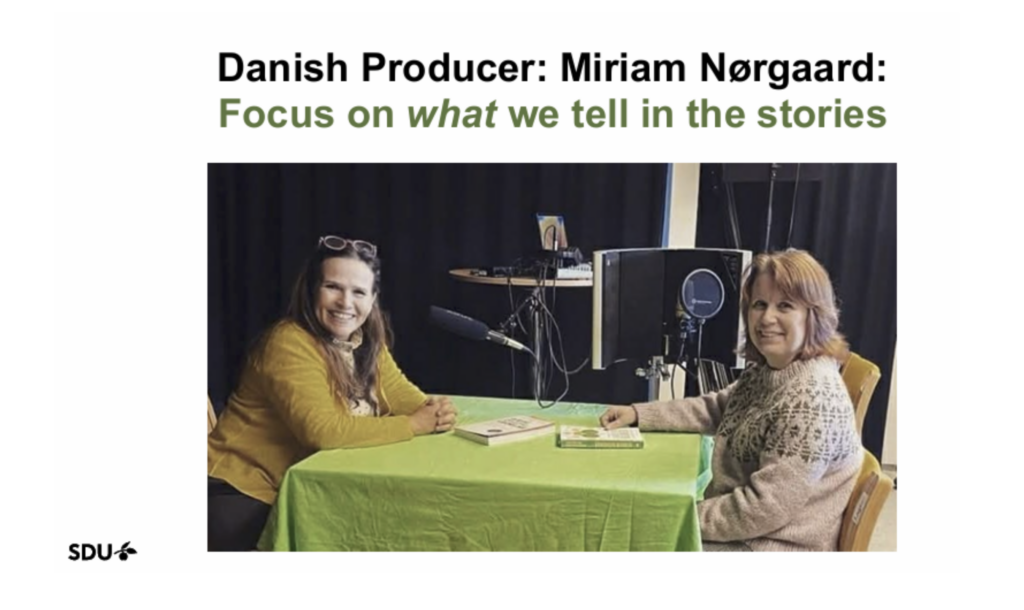
Focus on What We Tell in the Stories
When this industry is spending CO₂ emersions on producing media content, and of course they should. It becomes relevant to reflect not only on how they produce, but what they choose to produce.
Producer Miriam Nørgaard (from the company Growing Stories, and on the picture here) has argued that the filmmakers owe it to the climate situation – that when they spend CO2 on media productions, they better spend it on something important.
Can Stories Create Change?
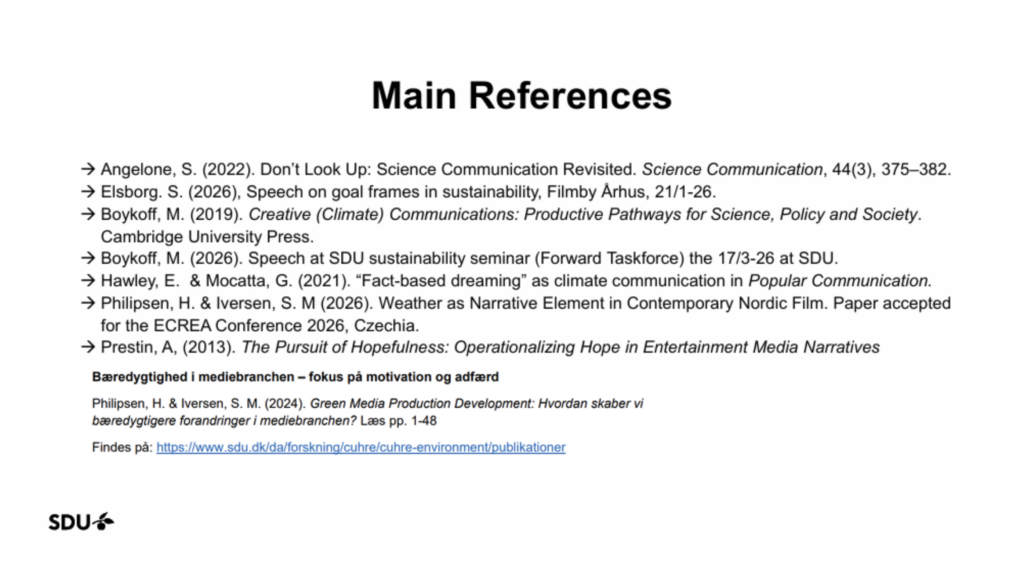
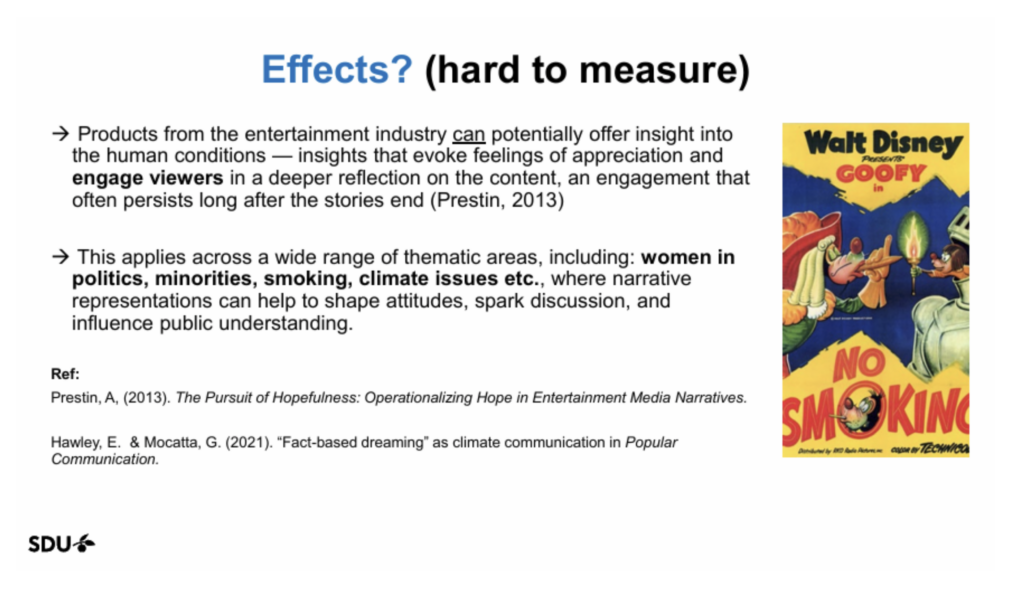
Studies on crisis communication – for example Hawley & Macotta (2021) – point out that storytelling can help to expand people’s imaginations, their sense of possibility, and their motivation to engage. Told in ‘the right’ and relatable ways.
They also demonstrate that hope and agency can be fostered through nuanced and non-manipulative narratives.
We moreover know from research, that stories (both documentaries and fiction) can help to shape how people imagine solutions for the future. How they understand their own agency, and which kinds of solutions they consider possible.
- Products from the entertainment industry can, according to researcher Abby Prestin (2013), potentially offer insight into the human conditions — insights that evoke feelings of appreciation and engage viewers in a deeper, more conscious and perhaps critical reflection on the content. An engagement that often persists long after the stories have ended.
This applies across a wide range of thematic areas, including: women in politics, minorities, smoking, climate issues etc., where narrative representations can help to shape attitudes, spark discussion, and influence public understanding.
- However, such effects are of course hard to measure. But we, the researchers, can try.
What Actually Moves People?
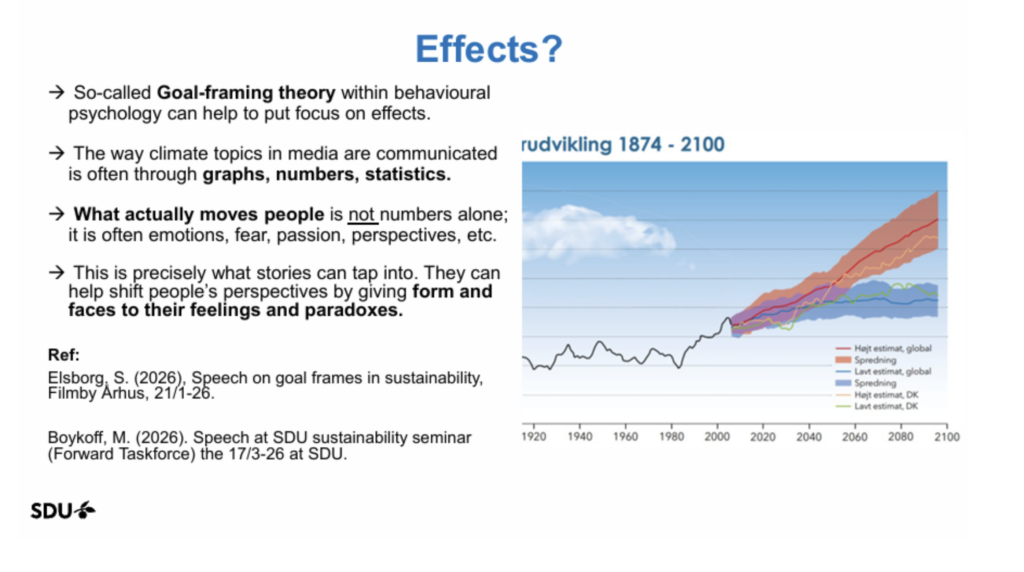
- So-called Goal-framing theory within behavioural psychology (Elsborg, 2026) can help to put focus on effects.
- The way climate topics in media are communicated is often through graphs, numbers, statistics.
- But what actually moves people is not numbers alone; it is often emotions, fear, passion, perspectives, etc.
- This is precisely what stories can tap into. They can help shift people’s perspectives by giving form and faces to their feelings and paradoxes.
In that sense, stories can either reinforce cultural patterns or contribute to opening new ones.
Climate Communication Fatigue
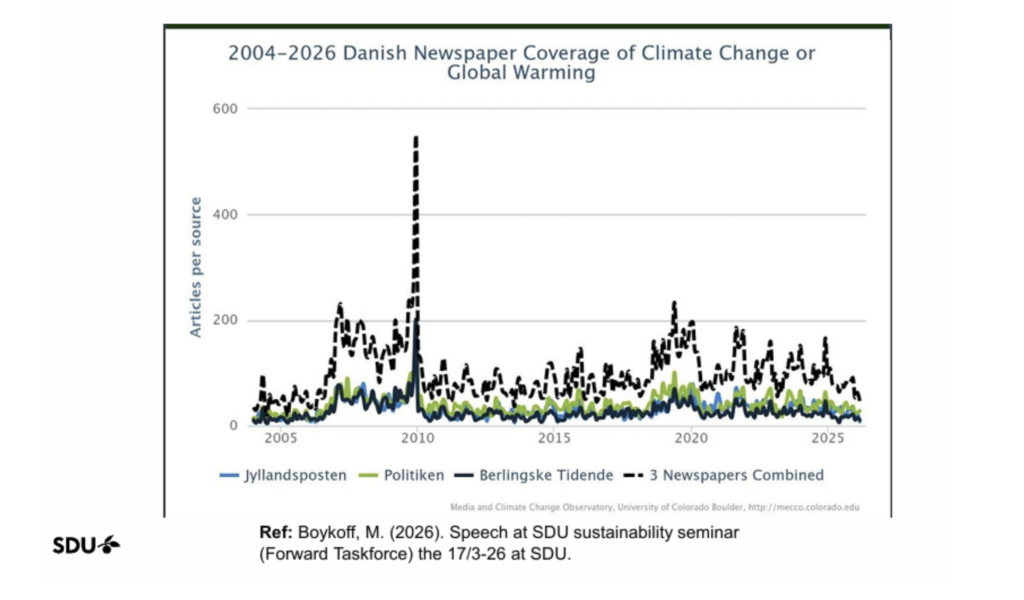
Research by the American researcher Maxwell Boykoff (2026) shows that the Danish media coverage of the climate crisis peaked around COP15 in 2009-10 – and has actually declined ever since.
From looking systematically at Jyllands-Posten, Berlingske, and Politiken’s climate communication Boykoff noticed a relatively low level in 2025.
One of the challenges is, that many people are tired of statistics, graphs, worst-case and also dystopian scenarios.
Beyond Dystopian Futures
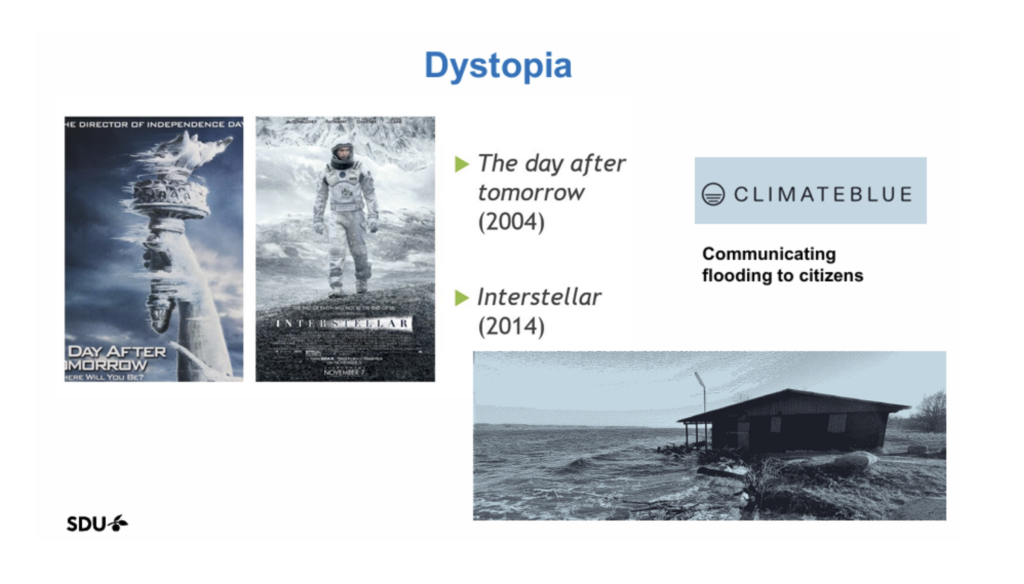
The same point can be made about some examples of film with dystopian topics. Especially the ones put into sci-fi future scenarios, very hard for audience to relate to.
Unlike crises such as pandemics or wars – climate crisis has no endpoint. Communicating it therefore requires long-term motivation and emotional endurance.
I am a part of a SDU Climate Cluster project called Climate Blue. Here we work for three years – with crise communication to citizens regarding flooding in DK and Germany.
In this project we also work with fiction stories as part of the debate with citizens.
Creative Climate Communication
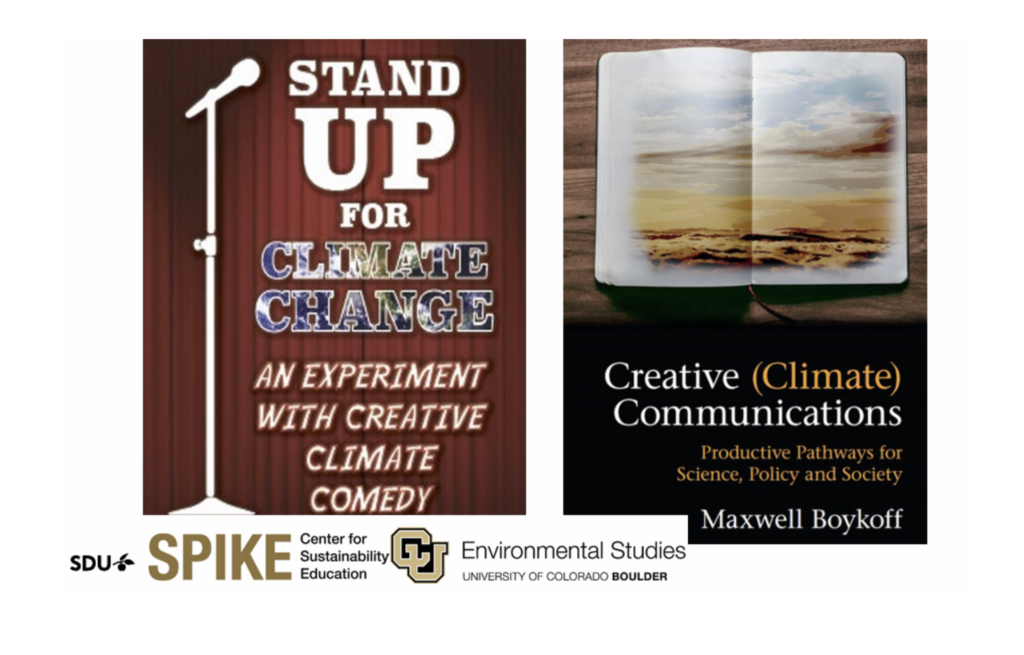
Maxwell Boykoff (2019) argues for more creative modes of engagement, pointing to formats such as climate-themed stand-up and comedies as new ways to reconnect audiences emotionally with climate debates.
He suggests a broader need for creative approaches to sustainability communication.
Film and series allow audiences to experience crises through characters — to understand their perspectives, dilemmas, and feelings.
And humor often shorten the distance between people. This is why “Stand up for climate” is an interesting concept.
Climate-Conscious Storytelling in Danish Film and TV
In some Danish film and series, we do find some examples of stories engaging meaningfully with climate-related themes.
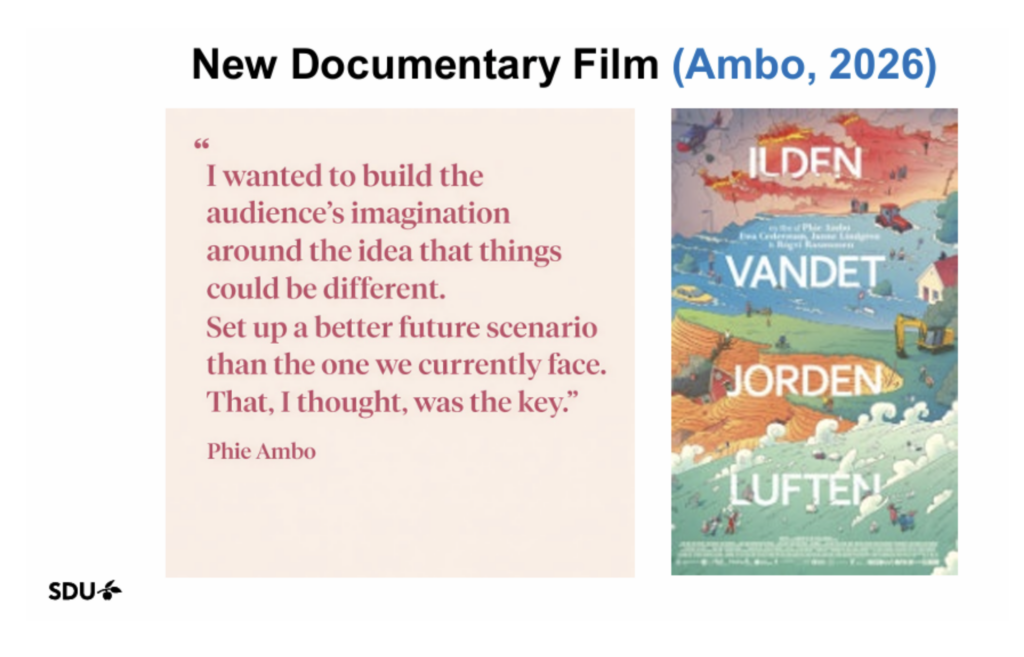
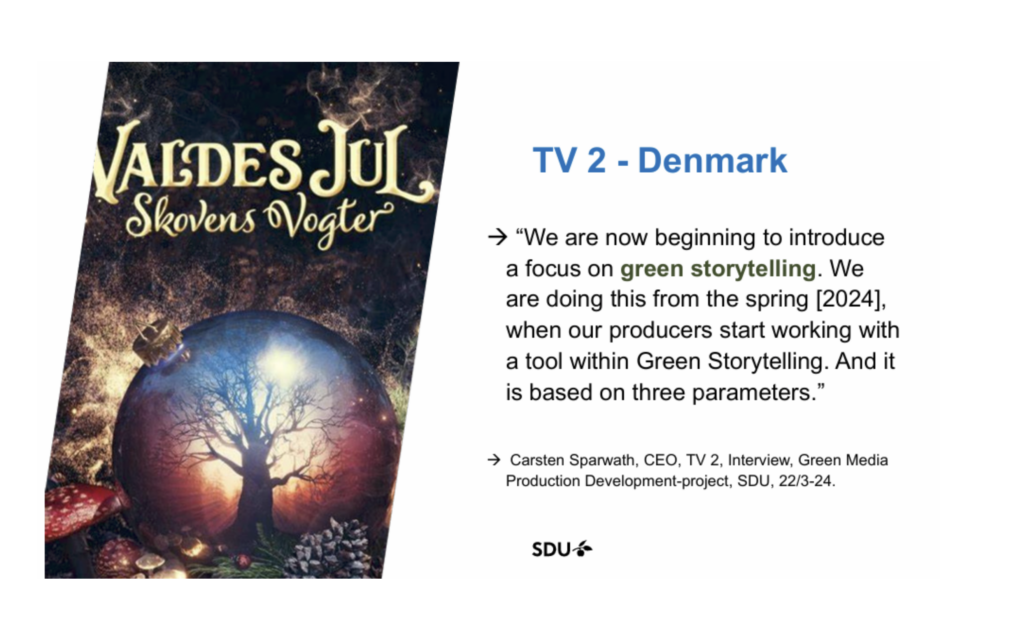
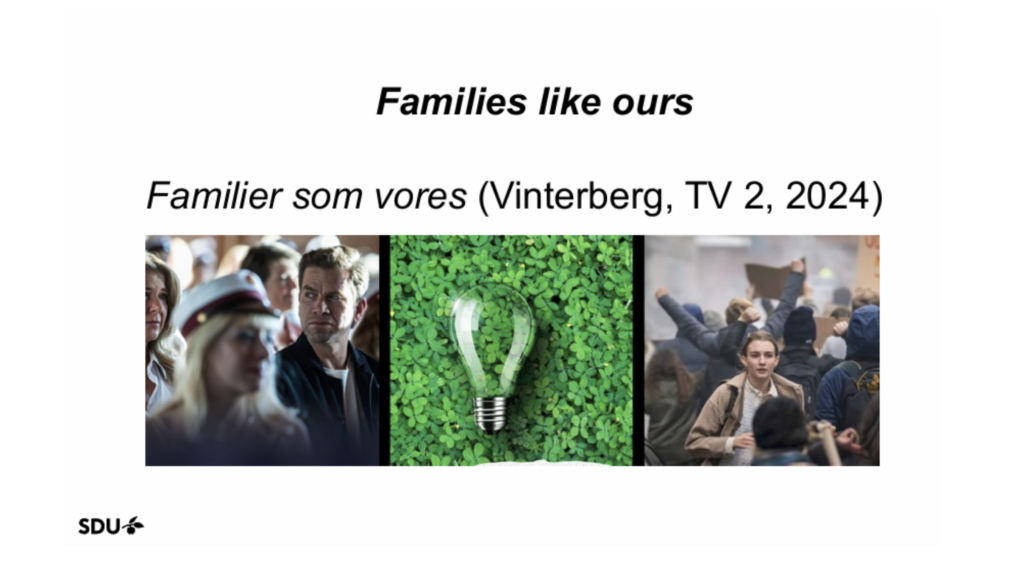
For instance, the TV 2 series Valdes Jul, or Families Like Ours. And Phie Ambo’s new documentary Fire, Water, Earth, Air (2026).
They try to explore human–and nature relations or climate challenges in thoughtful ways.
Such examples also demonstrate that climate-conscious storytelling IS possible and can be artistically rich also.
Sustainability as themes in film and series is of course NOT something that can be imposed on creators or audiences.
The task is to develop stories that invite reflection and make sustainable futures conceivable without prescribing them.
And not every screenwriter is interested in this. But some are, like Phie Ambo.
Green Storytelling in the Media Industry
However, different stakeholders in the media industry have started to ask storytellers for more so-called green storytelling. For instance, the Danish broadcaster TV 2.
“We are now beginning to introduce a focus on green storytelling. We are doing this from the spring [2024], when our producers start working with a tool within Green Storytelling. And it is based on three parameters.”
(Carsten Sparwath, CEO, TV 2, 22/3-24, in the “Green Media Production Development” project)
Underdog Characters, Hope and Agency
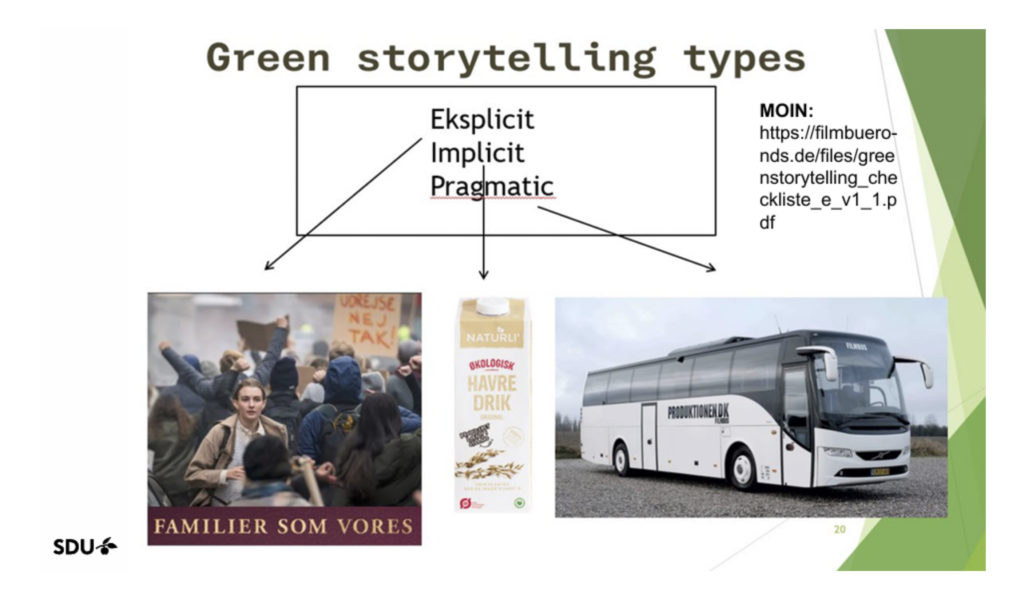
The series Families like ours is an example of green storytelling from TV 2.
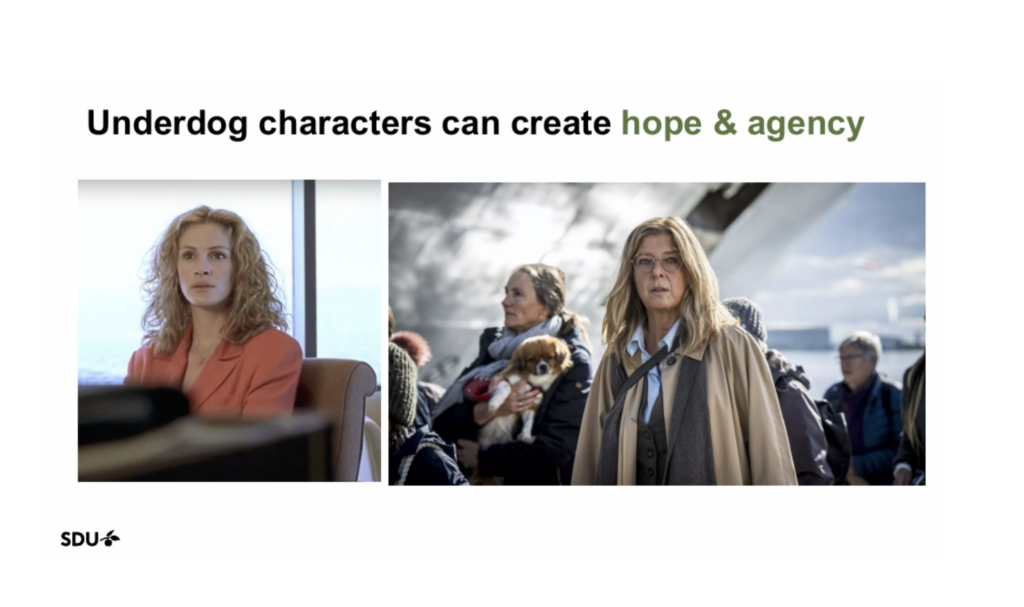
In stories with green storytelling, Underdog characters often manage to illustrate how agency can emerge even in constrained circumstances.
A well-known example is the Erinn Brockovich, or Fanny in Families like ours.
Audience Reflections on Climate Narratives
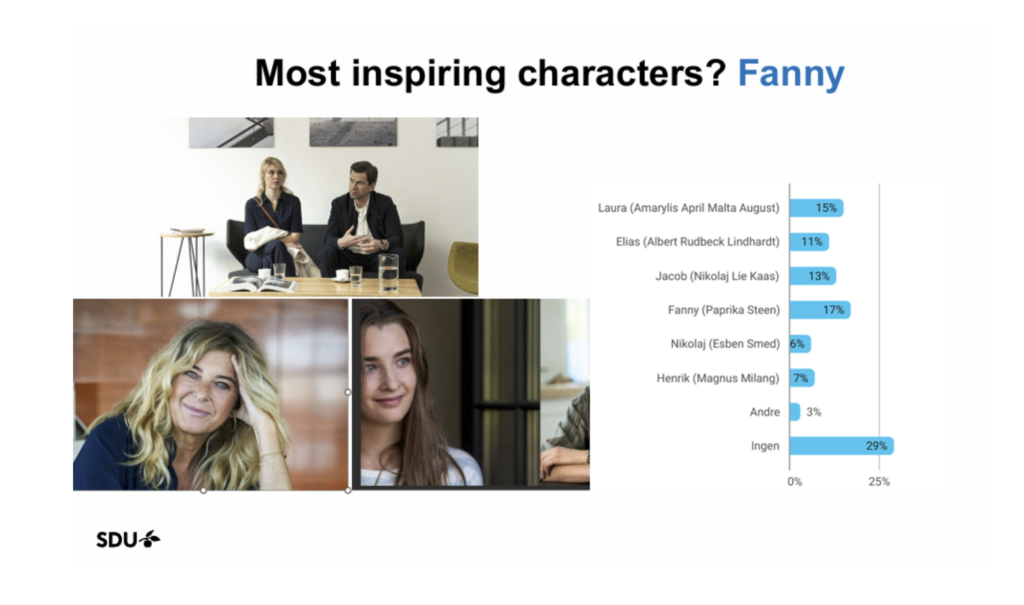
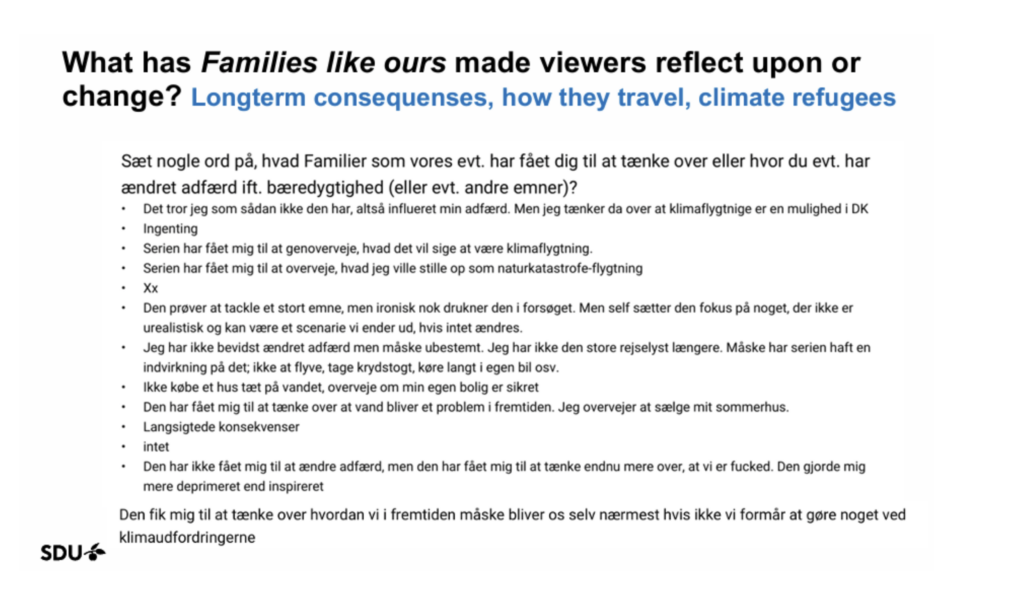
A survey on the reception of Families like ours, that two of my colleagues and I, carried out after the release of the series (2025), did show that Fanny (Paprika) Steen was the character that most of the respondents pointed out.
And she is ‘only’ the mother of the main character Laura. But Fanny is still pointed out in the survey as the most likeble character (with 17%).
The main point here is that themes like: Longterm consequenses, how they travel, how one would react to being a climate refugees, are among the things the respondents point out they get from the series.
Others are not inspired at all.
Let’s have a short look at, what green storytelling actually means.
What Is Green Storytelling?
You can find a so-called: Greenstorytelling checklist at the MOIN website:
https://moin-filmfoerderung.de/en/green-filming
By MOIN, green storytelling is divided into three categories, that screenwriters can potentially influence when writing stories: Explicit, implicit or pragmatic (production-wise).
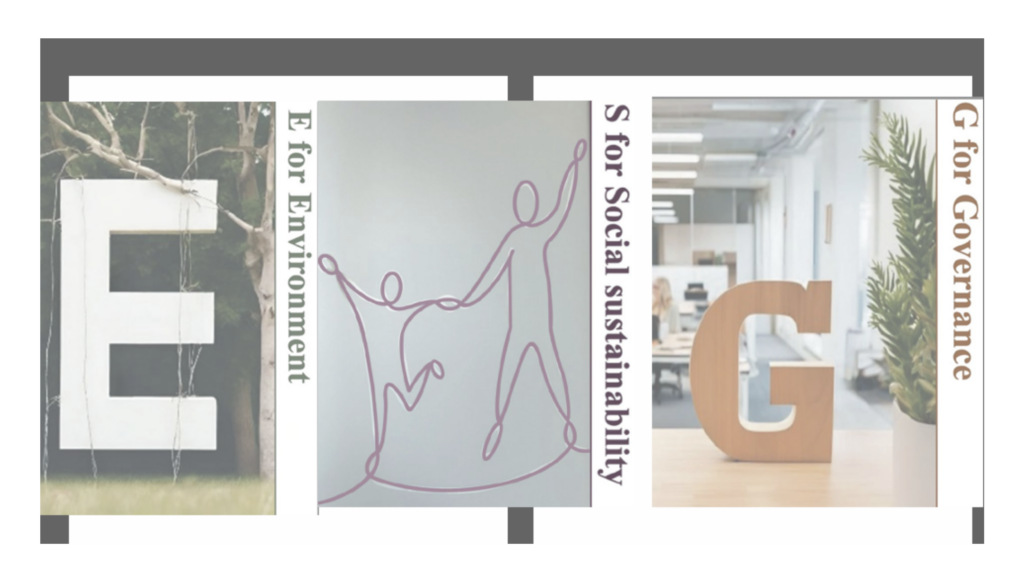
And then I would just like to mention, that sustainability can of course be brought into stories from a broader understanding of sustainability than just the E (Environmental).
In Families like ours, for example, all three angles (E, S ang G) are possible to locate.
Sustainability Starts at the Script Stage
So, to conclude, when we talk about sustainability in media, it may be useful to consider not only the footprint behind the camera, but also the imaginative worlds we place in front of it.
Screenwriters carry a responsibility here — not only producers and production companies do.
Many of the sustainable choices are actually made at the script stage:
How many night scenes you include.
Whether your main character shops second-hand and drink oat milk, or not, and so on.
And elements of sustainability can appear in a story in different ways — explicitly, implicitly, or through production-related choices.
Stories do not necessarily have to foreground climate crises, to make a difference.
So, it’s important that sustainability should be thought of holistically — from the very first idea to the final production — and by the whole team. And the whole ecosystem in the media industry.
Educational institutions also play a role in the ecosystem, including SDU.
At the education Screen Play Development (Manuskriptudvikling, SDU) we have therefore started to integrate these aspects of writing in our education.
And as researchers we can also make our knowledge visible to the media industry.
This is exactly the point of our website Greenstorytelling.dk.